
HOW MANY HOURS OF SLEEP ARE ENOUGH? — PART II
BHARAT 3026 — MY VISION FOR THE NEXT TEN CENTURIES
Technology Will Change. Generations Will Change. The World Will
Change. But the Principles That Sustain a Civilisation Must Not. How do
you write a plan for a country 1,000 years into the future? You don’t
predict its technology. You don’t decide its professions. You don’t design
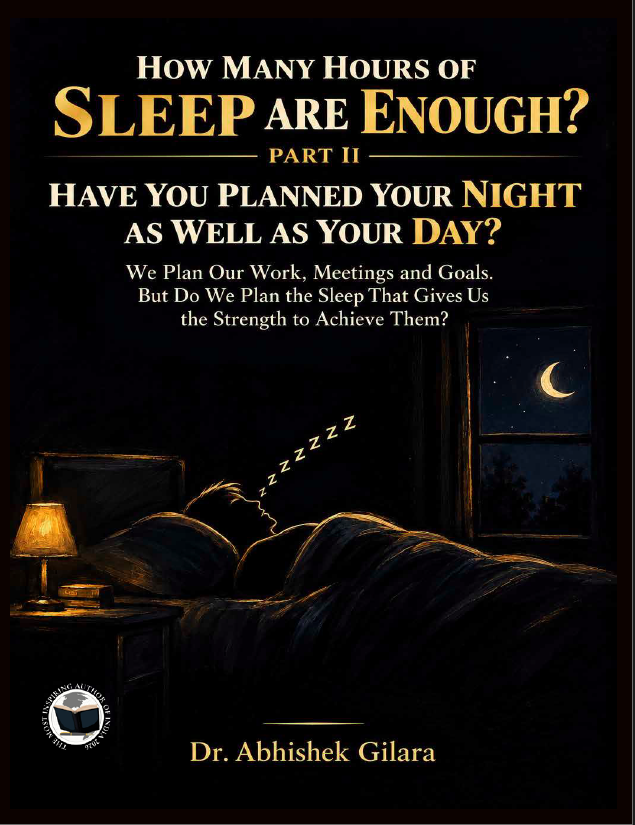
HOW MANY HOURS OF SLEEP ARE ENOUGH? — PART II HAVE YOU
PLANNED YOUR NIGHT AS WELL AS YOUR DAY? We Plan Our Work,
Meetings and Goals. But Do We Plan the Sleep That Gives Us the Strength to
Achieve Them? We plan our meetings. We plan our targets. We plan our exercise.
We plan our businesses. We plan our holidays. Some of us even plan an entire year
in advance. But when night arrives— planning often stops. The phone takes over.
Work continues. Entertainment stretches. Messages keep arriving. And sleep
receives whatever time is left. Dr. Abhishek Gilara asks a simple but provocative
question:
If we believe so strongly in managing our days, why don’t we manage our nights? In Part II of How Many Hours of Sleep Are
Enough?, he introduces his philosophy of Night Management—not as another productivity hack, but as a way of deliberately
protecting the part of life that prepares us for tomorrow. What should enter your mind before sleep? Should you review your
goals at night? Can waking experiences follow us into dreams? Can sleep help the brain process what we learned during the
day? And can we give our dreams direction without pretending we can completely control them? Drawing from his personal
routine, business philosophy, spiritual thinking, reading habits and fascination with sleep research, Dr. Gilara explores the
connection between planning, attention, memory, dreams, recovery and surrender. His conclusion is surprisingly simple: YOU
MAY NOT BE ABLE TO PLAN YOUR DREAMS. BUT YOU CAN PLAN HOW YOU ARRIVE AT SLEEP. Finish the day.
Delete unnecessary noise. Protect recovery. Feed your mind something worthwhile. Remember what matters. Plan tomorrow.
Then release it. Because the night should not become another office shift. It should prepare the human being who will return
to the office tomorrow. Tomorrow doesn’t begin when the alarm rings. Tomorrow begins tonight. PLAN YOUR DAY. PLAN
YOUR NIGHT. RESPECT BOTH.
Instead, you ask a deeper question: WHAT MUST WE NEVER ALLOW
HUMANITY TO LOSE? Bharat 3026 began with an ordinary morning
and an unfolded T-shirt—and one extraordinary realisation:
Tomorrow receives what today leaves behind. From that simple moment, Dr. Abhishek Gilara looks ten
centuries ahead and explores the principles he believes can remain meaningful even when almost everything
else has changed: Dharma. Character. Karma. Spirituality. Family. Health. Knowledge. Innovation.
Prosperity without greed. Nature. Strength. Peace. Trusteeship. And responsibility towards generations
yet unborn. Drawing inspiration from India’s civilisational wisdom and lessons from family legacy,
entrepreneurship, craftsmanship, fitness, spirituality and everyday life, this book makes one central argument:
A 1,000-YEAR PLAN SHOULD NOT TRY TO CONTROL 1,000 YEARS. Preserve the compass.
Let every generation redraw the map. We are not the final generation. We are trustees standing
between those who came before us and those who will come after us. The question is therefore not
merely: What did our ancestors leave for us? The greater question is: WHAT WILL OUR DESCENDANTS
RECEIVE FROM US? Receive. Strengthen. Pass Forward. Because Bharat 3026 will not be
built in 3026. It is being built today.
Technology Will Change. Generations Will Change. The World Will Change. But the Principles That
Sustain a Civilisation Must Not.
About the Book